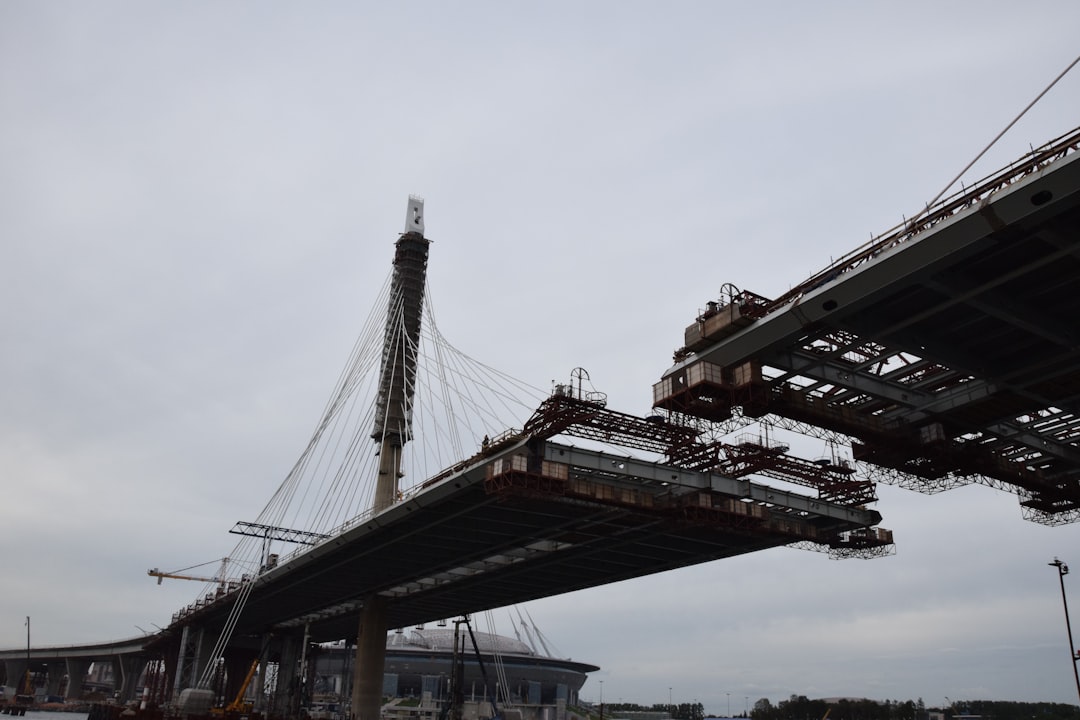
Bridge Inspector Detects Fatigue Cracks Before Scheduled Maintenance, Preventing Potential Collapse
Andreas Silva, a seasoned structural engineer in Barcelona, identified critical fatigue cracks during routine inspection, averting a possible structural failure. His expertise in non-destructive testing and fracture mechanics was crucial to ensuring public safety.

Photograph: Red Shuheart / Unsplash
The moment
In March 2023, Andreas Silva, a senior structural engineer with fifteen years of experience in bridge inspection and maintenance, arrived at the Mataró Bridge in Barcelona for a routine scheduled assessment. The bridge, a critical arterial route connecting neighborhoods and facilitating regional traffic, had been part of the city’s infrastructure for over three decades. Today’s inspection involved a combination of visual examination and nondestructive testing, specifically ultrasonic testing of key structural components. As Andreas methodically examined the steel expansion joints, he noted subtle irregularities—slight surface deviations and inconsistent ultrasonic signals—that warranted further investigation. His trained eye immediately recognised that these anomalies could be indicative of internal fatigue cracks, especially in areas subjected to repeated stress cycles.
While the routine nature of the inspection might have suggested a straightforward process, Andreas understood that these seemingly minor signs could be precursors to serious structural issues if left unaddressed. The bridge’s age, combined with recent traffic patterns and environmental conditions, had gradually contributed to material fatigue. His task was to determine whether these irregularities were benign or symptomatic of a developing failure mechanism.
Why years of experience made the difference
Andreas’s ability to correctly interpret the ultrasonic testing data stemmed from extensive, specialised training in fracture mechanics and nondestructive testing techniques. Over the years, he had developed a nuanced understanding of fatigue crack propagation in steel structures—a complex process involving incremental crack growth under cyclic loading, often difficult to detect in its early stages. Unlike superficial surface imperfections, internal fatigue cracks require careful analysis of ultrasonic signals, which can be complicated by noise, material heterogeneity, and geometry.
His familiarity with the Mataró Bridge’s original design—its weld details, steel grade, and load history—provided critical context. Andreas knew that certain weld geometries, high-stress concentration zones, and areas with prior repair history were more susceptible to crack initiation and growth. His knowledge of phased array ultrasonic testing (PAUT) equipment, combined with his experience in interpreting the specific signal patterns it produced, allowed him to distinguish between benign surface anomalies and internal cracks that could compromise structural integrity. This expertise was not solely derived from manuals or standard procedures; it was honed through years of fieldwork, careful pattern recognition, and an ongoing commitment to professional development.
Moreover, Andreas’s ability to integrate multiple sources of data—visual observations, ultrasonic signals, and design specifications—enabled him to form a comprehensive picture of the bridge’s condition. His deep understanding of fracture mechanics principles guided his interpretation: recognizing that even small cracks, if left unmonitored, could grow under cyclic stresses and lead to catastrophic failure. This level of insight was only possible through accumulated field experience and continuous technical education.
What happened next
Upon detecting suspicious ultrasonic signals within the welds and adjacent steel members—characterised by atypical amplitude and echo patterns—Andreas meticulously documented his findings. He cross-referenced the signals with previous inspection reports, noting that these irregularities were new and consistent with early-stage fatigue cracks. Recognising the potential severity, he collaborated with the maintenance team to formulate a targeted repair plan.
Using phased array ultrasonic testing, Andreas precisely mapped the extent and location of the internal cracks, focusing on high-stress concentration zones such as weld toes and stiffener attachments. Based on the severity and location, he recommended immediate repair interventions, including weld reinforcements and crack injection procedures to arrest crack growth. These repairs were scheduled during the upcoming maintenance window, planned to minimise traffic disruption.
His proactive approach and detailed technical assessment had several key outcomes. By identifying the cracks early, Andreas prevented the possibility of sudden failure in the bridge’s main span, which could have resulted in a catastrophic collapse. The scheduled repairs, informed by his expert analysis, ensured that the structural integrity was restored before any significant crack growth could compromise safety. The intervention not only protected the thousands of daily commuters who relied on the bridge but also avoided the potentially much higher costs and risks associated with emergency repairs or structural failure.
What this tells us
This case exemplifies how expert interpretation of nondestructive testing data is vital in infrastructure maintenance. Andreas Silva’s combination of technical knowledge, experience with fracture mechanics, and familiarity with specific structural details allowed him to identify critical issues early. It underscores the importance of continuous professional development in advanced testing techniques and the value of seasoned judgment in complex diagnostic scenarios. Such expertise enables timely, targeted interventions that prevent failures and safeguard public safety—proof that technical skill and experience are essential tools in infrastructure resilience.
- The Mataró Bridge had undergone periodic nondestructive testing as part of the city’s maintenance schedule, which includes ultrasonic testing for internal crack detection.
- Andreas had completed specialized training in fracture mechanics and ultrasonic testing techniques, enabling precise interpretation of complex signals.
- A failure of the bridge’s main span could have caused a catastrophic collapse, posing risks to public safety and disrupting regional traffic.
- He used phased array ultrasonic testing equipment to scan critical welds and steel components, paying close attention to areas of high stress concentration.
- His early detection and proactive repair plans averted potential disaster, ensuring continued safe use of the bridge.
| Subject | Andreas Silva (fictional name) |
| Role | Senior Structural Engineer with 15 years of experience in bridge inspection and maintenance at a major infrastructure agency in Barcelona |
| Location | Barcelona, Spain |
| Period | March 2023 |
| Field | Structural Engineering |
| Region | Europe |
| Outcome | Andreas’s timely identification led to targeted repairs, including weld reinforcements and crack injection, scheduled during the upcoming maintenance window. This prevented the risk of sudden structural failure that could have resulted in service disruption or accidents affecting thousands of commuters. |
This is an illustrative composite case inspired by documented patterns of professional practice in Structural Engineering. Names and identifying details are fictional to protect individual privacy. The techniques, procedures, and field-specific context reflect real professional practice. Written by Aino Virtanen on August 27, 2026. Questions: [email protected].